Ogbe Yono Eleke Necklace – 32 Inches Handmade for Babalawos
Handmade by initiated Santeros · unconsecrated, ready for your elder
1 verified reviews
$80.00
✦ Free U.S. shipping over $65 · Handmade by initiated devotees · Ships next business day from Texas ✦

Within Afro-Cuban religious traditions, particularly Santería (Regla de Ocha-Ifá), Lucumí, and Yoruba practices, there exists a complex hierarchy of spiritual leaders and practitioners. Each role carries distinct responsibilities, knowledge bases, and ceremonial functions that collectively maintain the integrity and continuity of these ancestral traditions. Comprehending the differences between an Oba Oriate, Babalawo, and Babalocha is essential for practitioners seeking appropriate guidance and for those interested in the organizational structure of these spiritual systems.
Religious authority in Afro-Cuban traditions is not monolithic but distributed across various specialized roles. This distribution ensures that no single individual holds complete power over all aspects of religious practice, creating a system of checks and balances. The differentiation between these roles stems from historical developments, regional variations, and the specific deities (Orishas) they serve.
For practitioners seeking authentic ritual items for their spiritual practice, understanding these roles helps ensure they acquire appropriate tools from knowledgeable sources. The Eleke Elegua, for instance, represents one such essential ritual item.
An Oba Oriate (literally "King of the Mat" or "King of Divination") occupies a position of profound significance within Santería ceremonies, particularly during initiations. This title represents the highest ceremonial authority in Regla de Ocha and requires decades of rigorous study and apprenticeship.
The Oba Oriate's primary function involves directing and performing complex initiation ceremonies (Kariocha), where new priests and priestesses are consecrated to their guardian Orisha. This demanding role requires encyclopedic knowledge of:
Unlike other religious roles, the Oba Oriate must possess extraordinary memory capacity, as the ceremonies they conduct may last several days and must be performed with precise accuracy. They interpret the patterns revealed through divination during ceremonies, determining the initiate's guardian Orisha and specific ritual requirements.
"The Oba Oriate embodies the living repository of oral tradition, preserving ceremonial knowledge that cannot be fully captured in written form. Their presence ensures ceremonial continuity across generations." — Traditional Lucumí proverb
Notably, while tremendously respected, the Oba Oriate does not necessarily have authority outside ceremonial contexts. Their specialization lies specifically in the orchestration of sacred rituals rather than everyday spiritual consultation.
The Babalawo (meaning "Father of Secrets" in Yoruba) represents the highest authority in Ifá, a sophisticated system of divination and wisdom literature originating from Yorubaland. While connected to Santería/Lucumí traditions, Ifá maintains its distinct ceremonial lineage and body of knowledge.
Babalawos undergo an intensive initiation and educational process focused on mastering the Ifá literary corpus, which contains 256 Odu (sacred patterns) with thousands of accompanying verses, parables, and prescriptions. Their primary responsibilities include:
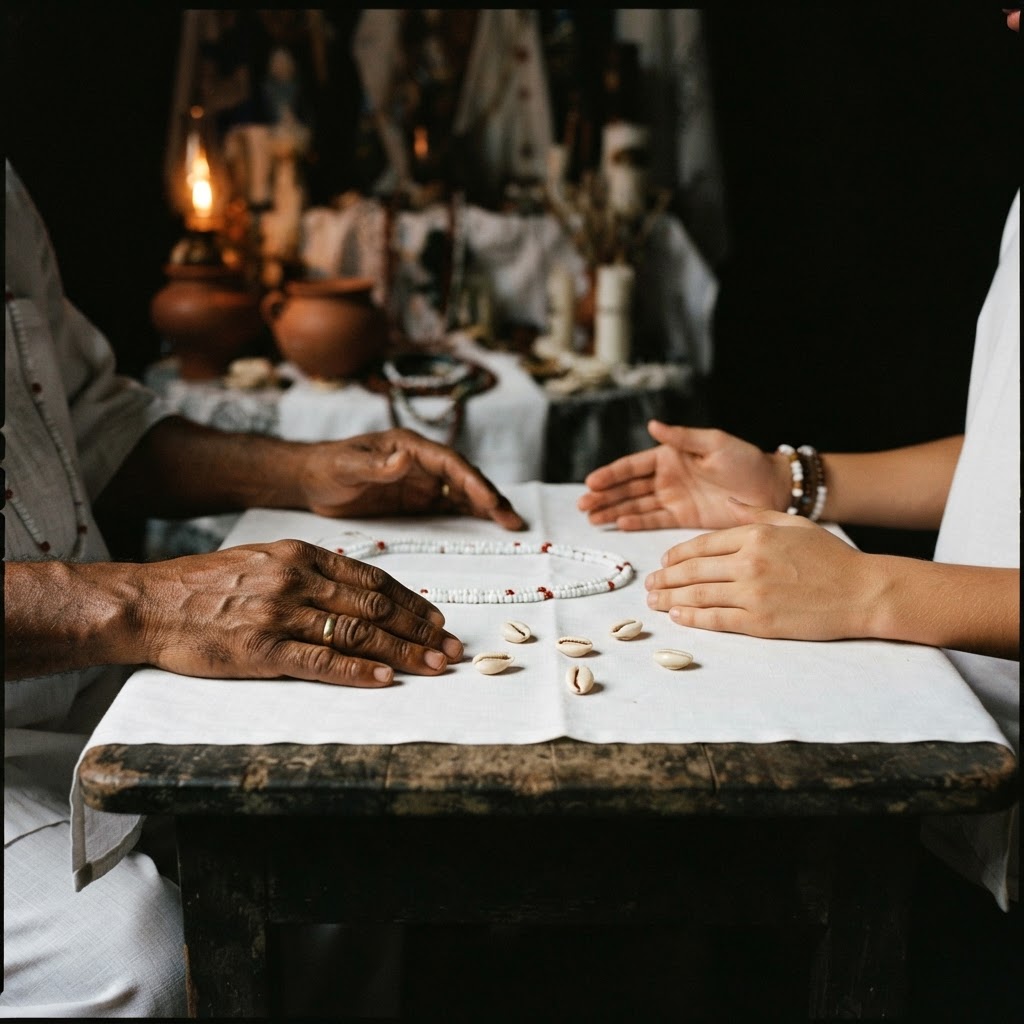
Divination through either the opele (divination chain) or ikin (sacred palm nuts) to access the wisdom of Orunmila, the Orisha of wisdom and prophecy. The interpretation of these divination results to diagnose spiritual issues, identify necessary offerings, and prescribe appropriate remedies. The performance of specialized ceremonies such as ebo (offerings), cleansings, and protective rituals.
A fundamental distinction between Babalawos and other religious authorities is their exclusive access to certain ceremonies, particularly those involving Orunmila and Oduduwá. Additionally, they perform the ebbo meta (three offerings) and various cleansing rituals that only Babalawos are permitted to conduct.
It's worth noting that traditionally, only men can become Babalawos, which distinguishes this role from others that are accessible regardless of gender. This gender restriction reflects historical Yoruba practices, though some contemporary communities have begun questioning these limitations.
If you feel called
Handmade by initiated Santeros · unconsecrated, ready for your elder
$80.00

Handmade by initiated Santeros · unconsecrated, ready for your elder
$75.00
Every piece ships unconsecrated so your elder can prepare it. Free US shipping over $95 · 14-day returns.
Babalocha (male) and Iyalocha (female), collectively known as Santeros and Santeras, are initiated priests and priestesses who have undergone the Kariocha ceremony, becoming consecrated to a specific guardian Orisha. These practitioners form the backbone of the religious community.
After completing their year as iyawo (new initiate) and receiving their "cuchillo" (knife ceremony), these priests and priestesses gain the authority to:
Unlike Babalawos, whose focus remains primarily on divination and specific ceremonies, Santeros and Santeras maintain daily relationships with the Orishas through regular offerings, celebrations, and ritual care. They serve as intermediaries between their religious community and the spiritual forces represented by the Orishas.
The distinction between a Babalocha/Iyalocha and an Oba Oriate lies in specialization rather than hierarchical superiority. While all Oba Oriates are Santeros, not all Santeros become Oba Oriates, as the latter requires additional training, aptitude, and recognition from the religious community.
To understand the relationship between these religious roles, it helps to examine their overlapping yet distinct ceremonial authorities. The following table summarizes key differences:
| Aspect | Oba Oriate | Babalawo | Babalocha/Iyalocha |
|---|---|---|---|
| Primary Divination System | Diloggún (16 cowrie shells) | Ifá (opele chain or ikin palm nuts) | Diloggún (typically limited to 12 shells) |
| Ceremonial Authority | Directs Kariocha (initiation) ceremonies | Performs Ifá-specific ceremonies and ebbo meta | Conducts smaller ceremonies and rituals for clients |
| Spiritual Focus | Ceremonial correctness and tradition | Oracular wisdom and destiny | Daily Orisha care and community guidance |
New to the tradition?
Plain-language introductions to the Orishas, the elekes and the etiquette of the house.
No spam. Unsubscribe anytime.
Everything we send is a starting point. Ritual work belongs in the hands of an initiated elder — find yours before you begin.
Can someone hold multiple religious titles simultaneously?
Yes, religious practitioners can hold multiple titles. A Santero may become a Babalawo through separate initiation into Ifá. Similarly, an experienced Santero may be recognized as an Oba Oriate after demonstrating exceptional knowledge and receiving community acknowledgment. Each role requires its specific initiation and training.
Is there a hierarchical superiority among these roles?
Rather than a linear hierarchy, these roles represent specialized functions within a complementary system. While certain ceremonies require specific authorities (e.g., only a Babalawo can perform certain Ifá rituals), each role maintains autonomy within its designated sphere of influence. The system functions through mutual respect and recognition of specialized knowledge domains.
How does one identify authentic religious authorities?
Authentic religious authorities in these traditions are recognized through their lineage (who initiated them), community acknowledgment, demonstrated knowledge, and ethical conduct. Legitimate practitioners can identify their religious godparents, the ilé (religious house) they belong to, and usually have relationships with other respected community members. Beware of those making extravagant claims without community connections.
Understanding these distinct yet complementary roles provides practitioners and spiritual seekers with the knowledge necessary to approach appropriate religious authorities for their specific needs, thereby preserving the integrity of these profound spiritual traditions.
Written by
Ali Romero
Initiated practitioner and writer at SanteriaGuide. Articles are reviewed by elders of the house before publication.
Before you decide
From the community
“As an aleyo I was nervous about buying the wrong thing. Their guides made it simple.”
Danielle P. · Atlanta, GA · Verified buyer
“The starter guide answered questions I was too shy to ask my padrino.”
Marcus T. · Chicago, IL · Verified buyer
“Clear explanations, no gatekeeping, and genuinely handmade pieces.”
Sofía G. · Los Angeles, CA · Verified buyer
Authenticity guaranteed
Handmade by initiated Santeros using traditional materials.
Fast, careful shipping
Ships next business day, wrapped for the altar.
30-day returns
Unused, unconsecrated pieces returned without fuss.
Secure checkout
Encrypted payment, card details never stored.
Related collection · View all 23 pieces
Herramientas de Ifá — handmade tools for Babalawos, apetebís and serious students of Orunmila and the Ifá tradition, made in the green and yellow that belong to him.
Keep reading