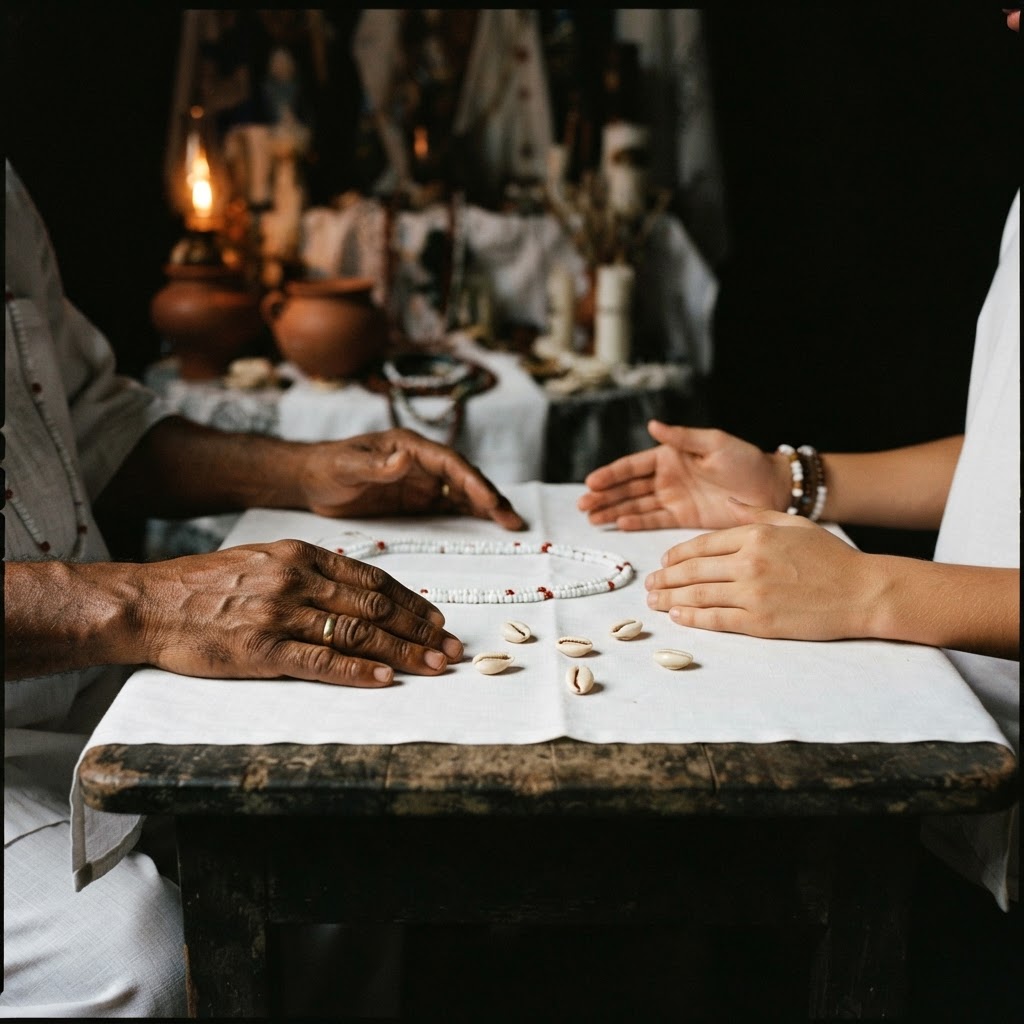
Ifá Eleke & Iléde Set – Large Glass Bead Necklace and Bracelet (4 Variants)
Handmade by initiated Santeros · unconsecrated, ready for your elder
Ships next business day
$50.00
✦ Free U.S. shipping over $65 · Handmade by initiated devotees · Ships next business day from Texas ✦
Behind the fees: Discover why Santeria practitioners charge and the value behind their ancient spiritual services. Dive in for surprising insights!

Within the sacred realms of Santería, Espiritismo, Palo Mayombe, and other African diasporic spiritual systems, the concept of exchange is fundamental. Many newcomers to these traditions often question why spiritual services require financial compensation. This inquiry touches upon deeper philosophical and practical considerations that have sustained these ancestral practices across generations and continents. The exchange of energy—whether through monetary compensation, offerings, or other forms of reciprocity—maintains the delicate balance between the material and spiritual worlds that practitioners navigate daily.
African diasporic traditions like Lucumí (Santería), Palo Mayombe, and Isese Ifa are living cultural repositories that survived the Middle Passage and centuries of oppression. These traditions emerged from complex religious systems in West and Central Africa, particularly Yorubaland (present-day Nigeria, Benin, and Togo), where spiritual knowledge was preserved through specialized priesthoods. In traditional Yoruba society, Babalawos, Olorishas, and other spiritual leaders devoted their lives to serving their communities, receiving compensation that sustained both them and their spiritual houses.
This ancestral precedent establishes an important framework: spiritual work has always been recognized as labor worthy of compensation. When we examine historical contexts, we find that spiritual practitioners were respected professionals whose expertise required years—often decades—of training and initiation. This expertise wasn't freely available but was transmitted through proper channels of initiation and reciprocal exchange.
Central to understanding spiritual compensation is the concept of ebbo (offering or sacrifice). In Santería and related traditions, nothing occurs without proper ebbo—a principle that extends beyond ritual actions to the entire spiritual economy.
In Lucumí tradition, all spiritual advancement requires sacrifice. This sacrifice takes many forms: time, effort, ritual materials, and yes, financial resources. When a client approaches a Santero, Santera, or Babalawo for spiritual work, they participate in this economy of sacrifice. The compensation provided enables the ritual offerings necessary for effective spiritual work while acknowledging the priest's dedication and expertise.
As one Oba Oriate (master of ceremonies) explains: "The ashé (spiritual power) must flow both ways. When a client gives nothing in return for spiritual assistance, they create spiritual imbalance that can actually hinder the very work they seek."
"In our tradition, we say 'Aché with aché is paid' (Aché con aché se paga). This means energy exchange must be reciprocal to maintain spiritual equilibrium. When we compensate our religious elders properly, we honor not just them but the ancestral covenant they uphold."
Beyond philosophical underpinnings, there are pragmatic reasons why practitioners in Santería and related traditions charge for their services.
Religious ceremonies in Afro-Cuban traditions require extensive material components. From the simplest cleansing (limpieza) to complex initiations (asientos), practitioners must procure specific items:
These materials represent significant investment. A Babalawo performing divination doesn't merely offer advice—they engage multiple deities through elaborate rituals requiring precise elements. The ceremonial supplies used in these traditions are often handcrafted by artisans who specialize in traditional methods, further emphasizing their value and the need for appropriate compensation.
For many established priests and priestesses, spiritual work constitutes their primary vocation. An Olocha (initiated priest/priestess) who has undergone the extensive initiation process has invested years of study and thousands of dollars in their own religious development.
The journey to becoming a qualified religious leader in traditions like Santería involves an apprenticeship model that requires:
| Type of Knowledge | Acquisition Process | Approximate Timeline |
|---|---|---|
| Ritual Procedures | Direct transmission from godparents | Years of observation and practice |
| Sacred Songs (Orikis) | Memorization of hundreds of ritual songs | Ongoing throughout religious life |
| Divination Systems | Special initiations and training | 1-7 years depending on system |
| Herbal Knowledge | Apprenticeship with elders | Lifetime of learning |
Related tools
Handmade by initiated Santeros · unconsecrated, ready for your elder
$50.00

Handmade by initiated Santeros · unconsecrated, ready for your elder
$15.00

Handmade by initiated Santeros · unconsecrated, ready for your elder
$300.00
Every piece ships unconsecrated so your elder can prepare it. Free US shipping over $95 · 14-day returns.
When clients compensate religious leaders, they acknowledge this vast repository of specialized knowledge. The Santero or Babalawo draws upon this expertise to address spiritual matters that mainstream modalities cannot resolve.
While compensation is appropriate, the community also recognizes the need to distinguish between fair exchange and exploitation. Ethical practitioners maintain transparency about costs and respect the financial circumstances of their godchildren and clients.
Traditional communities often establish general parameters for appropriate compensation. These aren't fixed prices but reflect consensus about what constitutes reasonable exchange for various services. Reputable houses of Ocha (ilé) typically:
The community recognizes that exploitation exists—practitioners who charge exorbitant fees or create unnecessary ceremonies for financial gain. However, this represents a deviation from traditional ethics rather than a reflection on the legitimacy of fair compensation.
Newcomers to these traditions often express hesitation about the financial aspects of spiritual work. Here we address some common questions:
Shouldn't spiritual help be free if it's truly about helping others?
Before you begin
What to ask before any ritual work begins — and what only an initiated elder can answer.
No spam. Unsubscribe anytime.
Everything we send is a starting point. Ritual work belongs in the hands of an initiated elder — find yours before you begin.
This question often stems from comparing African diasporic religions to mainstream religious models where clergy receive institutional salaries. In traditions like Santería, practitioners form a decentralized priesthood without institutional support. Their compensation comes directly from those they serve, maintaining the ancestral model of community support for spiritual specialists.
How can I determine if costs are reasonable?
Seek multiple opinions within the community. Speak with various elders about general costs for services. Established practitioners will be transparent about how fees are determined and what they cover. Remember that geographic location, material costs, and a priest's experience level all influence appropriate compensation.
What if I truly cannot afford spiritual services?
Ethical religious houses often provide options for those in genuine need. These might include payment plans, reduced fees for certain services, or community-sponsored ceremonies. The tradition teaches that the Orishas and Egun (ancestors) understand necessity, but this should not be exploited to devalue a priest's work.
The compensation of spiritual practitioners in Santería, Espiritismo, Palo Mayombe, Isese Ifa, and related traditions reflects a profound understanding of cosmic balance. By properly compensating those who perform spiritual labor, we participate in an ancient system of reciprocity that keeps these traditions vibrant and sustainable.
When we approach these traditions with respect for their economic dimensions, we honor not only the living practitioners but the ancestral lineages they represent. The exchange of energy—whether through monetary compensation or other forms of sacrifice—ensures that these sacred technologies remain accessible to future generations seeking spiritual guidance and connection.
Written by
Ali Romero
Initiated practitioner and writer at SanteriaGuide. Articles are reviewed by elders of the house before publication.
Before you decide
From the community
“The irofá arrived ready for work — solid, balanced, exactly as my babalawo wanted.”
Omar B. · Union City, NJ · Verified buyer
“Used the mazo in my iyawó year. It held up through everything.”
Lisette F. · Tampa, FL · Verified buyer
“Every knot tight, every bead correct. These people know the tradition.”
Rafael O. · Bronx, NY · Verified buyer
Authenticity guaranteed
Handmade by initiated Santeros using traditional materials.
Fast, careful shipping
Ships next business day, wrapped for the altar.
30-day returns
Unused, unconsecrated pieces returned without fuss.
Secure checkout
Encrypted payment, card details never stored.
Keep reading