Hand-Carved Yoruba Wooden Statue — Kneeling Figure Raising a Painted Bowl
Handmade by initiated Santeros · unconsecrated, ready for your elder
Ships next business day
$150.00
✦ Free U.S. shipping over $65 · Handmade by initiated devotees · Ships next business day from Texas ✦
Learn the essential tools, vessels, colors, and offerings required for a proper Orisha altar. Avoid costly mistakes before you set up your sacred space.
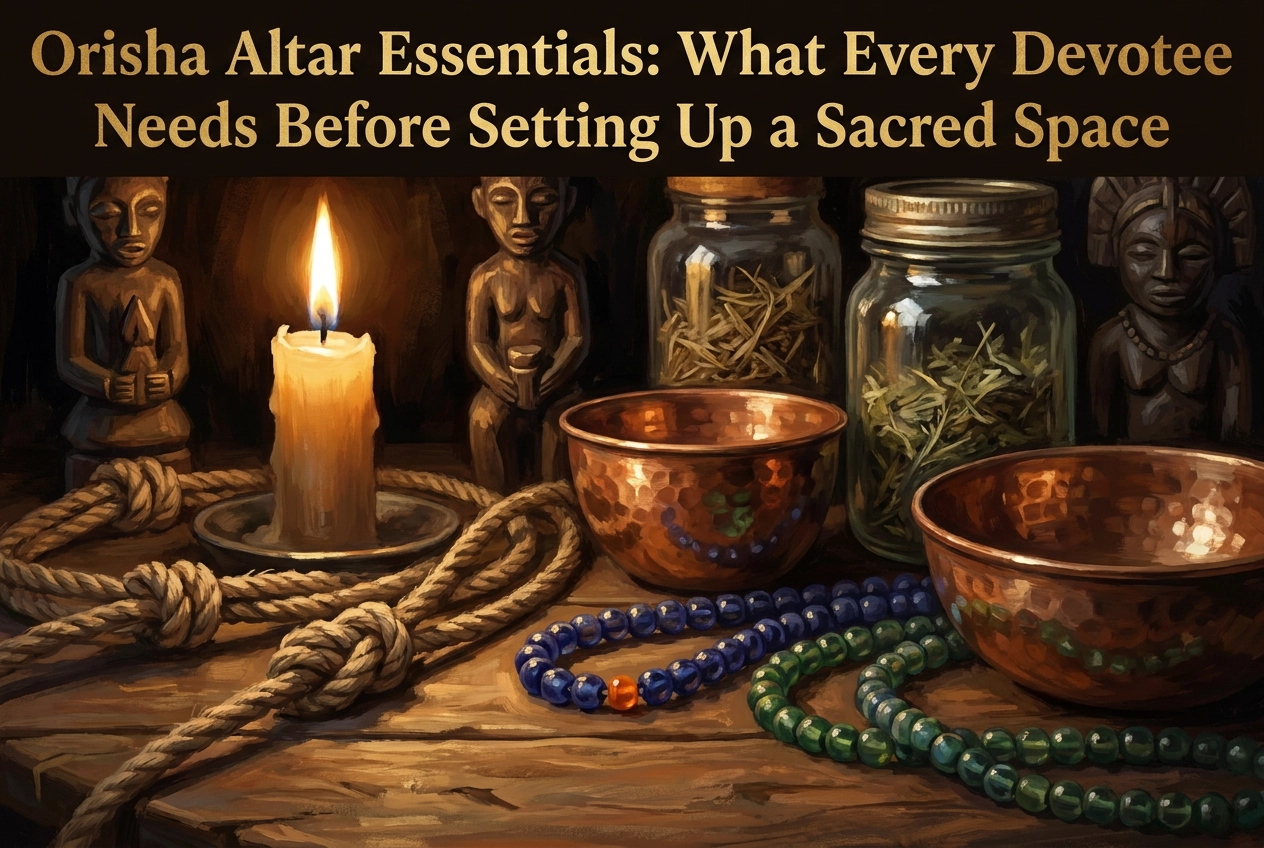
You would not build a house without a foundation, and you cannot build an Orisha altar without understanding the sacred protocols that give it power. Many beginners make the costly mistake of treating altar-building like interior decorating, choosing colors and objects based on what looks beautiful rather than what tradition requires. That approach does not just produce an incomplete altar. It can break the spiritual contract with the Orisha entirely.
Orisha worship spans multiple living traditions, including Lucumi, Candomble, Regla de Ocha, and Ifa, and each carries its own lineage-specific requirements for vessels, offerings, colors, and ritual tools. Before a single object is placed, before any Orisha is called upon, there are protocols to follow and foundational steps that must come first.
This guide is built for beginners who want to get it right from the start. You will learn why ancestor veneration must precede all Orisha work, which core items every altar requires, how requirements shift by specific Orisha, and which common mistakes demand expensive corrections. By the end, you will have the knowledge and a clear procurement framework to build your sacred space with confidence and integrity.
Most beginners approach their first Orisha altar the way they would interior decorating: they choose colors they find beautiful, arrange objects that feel meaningful, and build something visually striking. The result can look impressive and still be spiritually incomplete, or worse, spiritually incorrect.
In Orisha traditions, altar-building is not a creative act. It is a ritual act, governed by requirements that have been carried through lineages, houses, and generations. Orisha worship is described as a religion of practice rather than belief, which means the doing, and the doing correctly, is the point. What you place on an altar, what materials those items are made from, where they are positioned, and in what sequence they are assembled all carry weight that aesthetics alone cannot fulfill.
Each item placed on an Orisha altar functions as a signal. It communicates that a devotee understands what the Orisha requires and is prepared to honor that relationship with consistency. This is what practitioners mean by a spiritual contract: not a metaphor, but a real accountability that begins the moment you establish a sacred space. The Orisha does not receive the intention behind a wrong item. It receives the item itself, or it does not receive anything at all.
This distinction matters because substitution is not neutral. Using an incorrect vessel, an inappropriate material, or the wrong color does not simply leave a gap in the altar. Practitioners describe this as potentially rendering the space spiritually inert, meaning the Orisha is not present in a way that supports practice, or it can create an imbalance in the relationship that compounds over time.
The practical cost is real. Correcting an improperly assembled altar is not a matter of swapping out a few objects. According to established practitioners, it may require ceremony, qualified guidance, and the replacement of non-compliant items at additional expense. For orisha worshippers at any level of experience, getting the foundation right from the start is not just spiritually responsible. It is also the most economical path forward.
The variation runs deeper than tradition boundaries alone. As documented in federal guidelines on Orisha practice, customs vary from household to household and by geographic region. A practitioner initiated in Cuba, one initiated in Brazil, and one initiated in New York may each maintain altars that look and function differently, all within legitimate practice. There is no single universal altar blueprint across santeria practices.
This guide focuses on widely-shared baseline protocols, those that appear consistently across traditions, because they give beginners a responsible starting point. But baseline is not the same as complete. Every tradition carries requirements this guide cannot fully capture, and every lineage may hold specific instructions that override general guidance.
That is precisely where the Oriaté and godparent become irreplaceable. Within Regla de Ocha practice, the Oriaté is a consecrated ritual specialist whose authority over ceremonial protocol is foundational. Your godparent carries direct responsibility for guiding you through initiation and altar construction within your specific lineage. A written guide supplements their instruction; it does not replace it.
For diaspora practitioners in the United States who are still seeking a godparent or lineage community, the challenge is real. Access to initiated elders is not equally distributed. In that gap, sourcing materials from vendors who work within the tradition and use verified, traditional specifications becomes especially important. Authentically made tools reflect the protocols the tradition requires, even before formal initiation brings personalized guidance. The sections that follow are built on that same principle: tradition-accurate from the start.
Regardless of which tradition or lineage you follow, one principle holds without exception: you do not approach the Orishas before you have acknowledged your ancestors.
Egun, the collective term for one's ancestral spirits, are held in the highest esteem across every branch of Orisha practice. Every ceremony, every ritual, every act of devotion opens with homage to the ancestors. This is not a suggestion or a regional custom. It is the foundational protocol of the entire spiritual system.
The ancestral altar comes first. Known as a bóveda in Spiritist-influenced traditions or simply an egun space, this altar is not a companion piece to your Orisha altar. It is the ground on which all Orisha work stands. Assembling an Orisha altar without first establishing an active ancestral space is a protocol violation recognized across traditions, regardless of lineage.
As commonly described across Spiritist-influenced Orisha traditions, the components of a basic ancestral altar are intentionally simple:
A white cloth covering the surface
A glass of fresh water to refresh and invite the spirits
A white candle for light and spiritual clarity
A photograph or personal memento of a deceased family member to anchor the connection
These items are the minimum. What makes them effective is consistent attention, not elaborate presentation.
Skipping egun work is not a minor shortcut. Practitioners across traditions describe approaching the Orishas without first honoring the ancestors as spiritually presumptuous, the equivalent of entering a house without greeting its elders. The ancestors are intermediaries. Their cooperation supports everything that follows.
An active egun practice means regular engagement: speaking to your ancestors, offering fresh water, lighting a candle, and acknowledging them before any spiritual work. This consistency builds the relationship. A neglected ancestral altar is not a neutral absence; it is a missed foundation that weakens the structure above it.
Before you purchase a single item for an Orisha altar, establish your egun space. That single step is the most important procurement decision you will make.
With the ancestral foundation in place, attention turns to the Orisha altar itself, and here, every item carries weight.
The Sacred Vessel
Within Lucumí and Regla de Ocha lineages, tradition holds that each Orisha resides in a specific vessel: a sopera, tureen, clay pot, iron cauldron, or covered receptacle. The material, color, and form are prescribed by tradition. Ogun's vessel is iron because iron is his domain; Oshun's is brass or gold-toned because it reflects her correspondence with rivers and wealth. Substituting a ceramic bowl for an iron cauldron, or painting any container the "right" color, does not satisfy the requirement. The vessel type itself is part of the protocol.
Ritual Tools and Implements
Each Orisha is accompanied by specific implements: a sword, a double-headed axe, a fan, a bow and arrows, a shepherd's crook. These must be made from appropriate materials, specific metals, hardwoods, or natural fibers, because material composition is part of what makes the tool spiritually functional. A lightning axe cast in plastic is not an approximation; it is a different object entirely.
Ildes and Beaded Items
Beaded necklaces (collares) and ritual Ildes carry tradition-specific color sequences that identify the Orisha and establish a direct energetic correspondence. Bead color, pattern, and material all matter. Synthetic beads or incorrect color sequences compromise the item's integrity. This is not aesthetic preference; it reflects how the tradition encodes spiritual identity into physical objects.
Candles and Lamps
Candle color is prescribed per Orisha, not interchangeable. Placing a white candle at Chango's altar when his color protocol calls for red and white is a substitution, not an equivalent. Quantity and placement carry meaning as well. A single generic white candle is appropriate only at the ancestral space, where it belongs specifically.
Offerings (Adimú)
Offerings are Orisha-specific and non-interchangeable. Elegua receives smoked fish, jutia, and coconut. Yemaya accepts watermelon, molasses, and fish. Chango's adimú includes apples, red wine, and cornmeal. Oshun receives honey, pumpkin, and oranges. Presenting Oshun's offerings to Chango, or vice versa, misidentifies the relationship entirely.
Water Vessels
Fresh water in a designated vessel is an active, living element on an Orisha altar, not decoration. It must be refreshed regularly and housed in the appropriate vessel type for the Orisha it serves. Neglecting it, or treating it as optional, removes a functioning component from the altar's protocol.
If you feel called
Handmade by initiated Santeros · unconsecrated, ready for your elder
$150.00

Handmade by initiated Santeros · unconsecrated, ready for your elder
$150.00
Every piece ships unconsecrated so your elder can prepare it. Free US shipping over $95 · 14-day returns.
Those per-Orisha specifications translate the general principles into concrete requirements. Within Lucumí and Regla de Ocha lineages, tradition holds that the following applies for six foundational Orishas.
Elegua (feast day: June 13) is acknowledged first in every ritual space, without exception. His colors are red and black. His vessel is small, made from clay or cement, and belongs at the entrance to the home or directly behind the door. Offerings include smoked fish, jutia, and coconut.
Yemaya (feast day: September 7) governs the ocean, and every element of her altar must reflect that domain. Her colors are blue and white. Her vessel is a tureen or sopera in those same colors. An altar de santeria built for Yemaya calls for offerings of watermelon, molasses, and fish. Substituting inland or unrelated items breaks the correspondence her altar requires.
Chango (feast day: December 4) is honored in red and white. His vessel is a wooden batea or covered container in his colors. Offerings include apples, red wine, and cornmeal. His primary ritual tool is the oshe, a double-headed axe that must be crafted from appropriate materials; a decorative or incorrectly made oshe does not fulfill the requirement.
Oshun governs rivers and fresh water. Her colors are yellow and gold, and her vessel should be brass or gold-toned to match. Offerings include honey, pumpkins, and oranges. A widely observed protocol requires that before offering honey to Oshun, the devotee always tastes it first. This is not optional.
Obatala is associated with white exclusively. His vessel is covered in white cloth, and his offerings are white foods: coconut, meringue, and white rice. His placement on the altar is elevated above the other Orishas, reflecting his spiritual seniority. That elevation is a structural requirement, not a stylistic choice.
Ogun is honored in green and black. His vessel is an iron cauldron, and unlike other Orishas where vessel materials have some variation across households, Ogun's iron implement is non-substitutable. Offerings include rum, cigars, and roasted yam. Ogun and Obatala are traditionally kept apart due to the nature of their energies. Because the integrity of Ogun's iron tools depends entirely on the material and craftsmanship, sourcing from a botanica orisha or a practitioner-verified vendor is not a convenience; it is a protocol requirement. An aluminum or resin substitute misrepresents the Orisha entirely.
Knowing which materials each Orisha requires is only half the equation. The other half is understanding that substituting those materials, even with visually similar alternatives, is not a workaround. It is a protocol failure.
Material composition is a requirement, not a preference. The tradition specifies iron, brass, wood, clay, and natural beads because these materials carry distinct properties that synthetic alternatives do not replicate. In the view of traditional practitioners, a plastic vessel does not hold the same spiritual charge as a clay or ceramic one, and synthetic fabric does not carry the same resonance as natural fiber. Acrylic paint applied to items that require natural pigments introduces a material incompatibility the tradition recognizes even when the eye does not. Commercially-dyed beads in approximated color sequences compound the problem further, because bead color sequences for Ildes and ritual items are not decorative choices; they are identity markers for each Orisha.
Mass-produced tools introduce a separate issue. A machine-made implement carries no practitioner intention and was not made within a tradition-informed process. Handcrafted tools made by practicing devotees using traditional materials and methods are recognized differently within the tradition precisely because the maker's knowledge and care are part of what the object carries. This is not sentiment; it is a foundational principle of how sacred implements function in Orisha practice.
As Oriaté and lineage elders consistently teach, incorrect materials can force reconsecration. This is not a simple re-blessing. Depending on what was done and how far the work progressed, it may require the involvement of a qualified Oriaté, additional ceremony, and full replacement of the non-compliant items. The financial and ceremonial cost often exceeds what correct sourcing would have required from the start.
When purchasing from a botanica orisha or online retailer, ask direct questions: What is the item made from? Who made it? Does it follow tradition-specific material and color protocols for this Orisha? Was it made by a practicing devotee? Retailers who cannot answer these questions clearly are not the right source for ritual items. Prioritize vendors who are transparent about materials and whose items are crafted by practitioners with working knowledge of the tradition.
Getting the materials right is only half the work. Where you place each Orisha in your space is equally prescribed, and position is not interchangeable.
Elevation reflects spiritual hierarchy. Obatala holds the highest rank among the Orishas, and his vessel is placed accordingly, elevated above all others, often on a high shelf or dedicated upper space. Elegua, by contrast, lives at or near the floor, positioned at the entrance to the home or behind the front door. This is not symbolic preference; it reflects each Orisha's domain and rank within the tradition.
Separation is a requirement, not a suggestion. Certain Orishas should not share the same physical altar surface or be placed in close proximity to one another. A godparent or lineage elder is the authoritative source for the specific separations that apply within your tradition, but beginners should know that crowding multiple Orishas onto one shared shelf without guidance is a common and consequential error.
Location follows domain. Yemaya's altar belongs near water when possible, reflecting her oceanic dominion. Elegua's position at the doorway is tied directly to his role as the opener of paths. The floor, the threshold, and water-adjacent spaces are not decorative choices; they are cosmologically meaningful positions that honor each Orisha's nature.
Maintenance is ongoing protocol. An Orisha altar is a living relationship. Offerings must be refreshed on tradition-specific schedules, spent materials removed promptly, and the space kept clean. Neglect communicates disrespect and disrupts the relationship you are working to build.
Feast days require direct preparation. On Elegua's feast day (June 13), Yemaya's (September 7), and Chango's (December 4), devotees add fresh offerings, clean the space thoroughly, and give the altar focused attention. These are not optional observances; they are active demonstrations of commitment that the tradition expects.
New to the tradition?
Plain-language introductions to the Orishas, the elekes and the etiquette of the house.
No spam. Unsubscribe anytime.
Everything we send is a starting point. Ritual work belongs in the hands of an initiated elder — find yours before you begin.
Knowing where each Orisha lives in your space is necessary preparation. Knowing what to buy, and in what order, is what makes that space functional before a single item is placed.
Follow this procurement sequence without exception:
Ancestral altar materials first: as commonly described across Spiritist-influenced Orisha traditions, a white cloth, a glass of water, and a white candle form the essential starting point
The vessel for your primary Orisha, in tradition-prescribed material and color
Ritual tools specific to that Orisha
Adimú offerings appropriate to that Orisha's preferences
Decorative elements last, only after all functional items are in place
Reversing this order is the procurement equivalent of skipping egun work entirely. Aesthetics have no standing until the protocol is satisfied.
Source with intention, not just convenience.
Not every botanica orisha or online retailer applies the same standards. Before purchasing any item, ask three questions directly: What material is this made from? Who made it? Does it follow tradition-specific color and material protocols for this Orisha?
Santeria Guide offers handcrafted Orisha ritual tools and sacred spiritual jewelry, including Ildes, made by devotees using traditional materials and tradition-accurate specifications. These items are not consecrated, and that distinction matters.
Understand the consecration boundary.
As understood within established lineages, unconsecrated ritual items, including vessels, tools, and beaded items made to correct specifications, can and should be sourced from a reputable vendor. Consecration is a separate act performed by a qualified practitioner within your lineage. Confusing these two categories leads beginners to either overpay for items falsely sold as spiritually activated, or to assume that purchasing the right object replaces the consecration step entirely. Neither is correct.
Your baseline starting checklist:
Ancestral altar: white cloth, glass of water, white candle
Primary Orisha: tradition-accurate vessel, Orisha-specific beaded items in correct colors, first adimú offering
Confirm material composition on every item before purchase
This list is a floor, not a ceiling. Your godparent or lineage authority will build on it according to your specific path.
Even with the right items sourced, the way a devotee assembles and maintains an altar determines whether the practice holds. These are the mistakes that most frequently require correction, and in some cases, full reconsecration.
Bypassing the ancestral altar. The egun foundation covered earlier is not a formality, skipping it means revisiting every subsequent step.
Choosing vessels by appearance rather than prescription. A blue ceramic bowl may look appropriate for Yemaya, but if the material, form, or finish does not meet the tradition-specific requirement for her sopera, it is not a functional sacred vessel. The same applies to color substitutions made because the correct shade was unavailable. Aesthetics are not a permissible standard here.
Purchasing mass-produced tools without verifying materials or maker. Using mass-produced tools without confirming material composition and maker tradition is a protocol failure covered in the materials section, and one of the most common procurement errors.
Positioning Orishas without understanding relational dynamics. Placing Orishas without understanding relational dynamics, especially which Orishas cannot share space, requires practitioner guidance to address, not just rearrangement.
Treating the altar as a finished installation. An Orisha altar is a living practice. Offerings left unattended past their proper time, feast days that pass without acknowledgment, and extended periods without maintenance all represent neglect that accumulates. Feast days for Elegua, Yemaya, and Chango require fresh offerings and focused attention, not optional observances.
Mixing protocols from incompatible traditions. Combining Lucumí and Palo Mayumbe practices on a single altar without initiation into both paths is a protocol violation recognized across both traditions, not an act of comprehensiveness, and carries real implications. Each tradition carries its own spiritual logic, and merging them without the authority to do so creates conflicts that cannot be resolved by good intentions alone.
Every mistake covered in the previous section shares a root cause: the altar was treated as something to build rather than a commitment to enter. That distinction is the foundation of everything in this guide.
An Orisha altar is a protocol-driven spiritual relationship. The items you source before you begin are not decorations or accessories; they are the terms of that relationship. Getting them right from the start preserves the integrity of what you are building.
The non-negotiables, egun first, Orisha-specific requirements identified, and tradition-accurate materials sourced, have been detailed in the preceding sections; apply them in sequence. Santeria Guide offers handcrafted ritual tools and sacred spiritual jewelry, including Ildes, made by devotees using traditional materials and traditional specifications.
Where possible, seek guidance from a godparent or lineage elder. A knowledgeable practitioner can confirm tradition-specific requirements that no written guide can fully replace.
Finally, remember that santeria practices are living traditions, not a project with a completion date. Patience, continued study, and consistent respect for protocol are what sustain a devotee's relationship with the Orishas across years and decades. The altar you build today will evolve as your knowledge deepens. Begin correctly, and that evolution will carry the integrity of a strong foundation.
Building an Orisha altar is one of the most significant commitments a devotee can make, and doing it correctly from the beginning changes everything. Honor your ancestors first, know your Orisha's specific requirements, and source only tradition-accurate materials from verified practitioners.
The foundation you lay now determines the integrity of every spiritual relationship you build going forward. Shortcuts in materials, placement, or protocol do not save time; they create problems that require costly corrections later.
Take the next step with confidence. Review your Orisha's specific color, vessel, and offering requirements, establish your ancestral altar, and build your procurement list before purchasing a single item. When you are ready to source handcrafted, tradition-accurate ritual tools and sacred jewelry made by devotees, Santeria Guide is here to support your practice at every stage.
Begin with intention. Build with knowledge. Honor the tradition fully.
Before you decide
From the community
“As an aleyo I was nervous about buying the wrong thing. Their guides made it simple.”
Danielle P. · Atlanta, GA · Verified buyer
“The starter guide answered questions I was too shy to ask my padrino.”
Marcus T. · Chicago, IL · Verified buyer
“Clear explanations, no gatekeeping, and genuinely handmade pieces.”
Sofía G. · Los Angeles, CA · Verified buyer
Authenticity guaranteed
Handmade by initiated Santeros using traditional materials.
Fast, careful shipping
Ships next business day, wrapped for the altar.
30-day returns
Unused, unconsecrated pieces returned without fuss.
Secure checkout
Encrypted payment, card details never stored.
Related collection · View all 0 pieces
Herbal tea blends — all-natural blends made for specific wellness goals, with no additives, no artificial flavours and no caffeine beyond what the herbs themselves carry.
Keep reading