Collar De Bandera
Handmade by initiated Santeros · unconsecrated, ready for your elder
Ships next business day
$40.00
✦ Free U.S. shipping over $65 · Handmade by initiated devotees · Ships next business day from Texas ✦
Discover the traditional perspective on reading a firma in Palo Mayombe. Learn why these sacred symbols are read as a whole and why you should avoid generic interpretation keys.
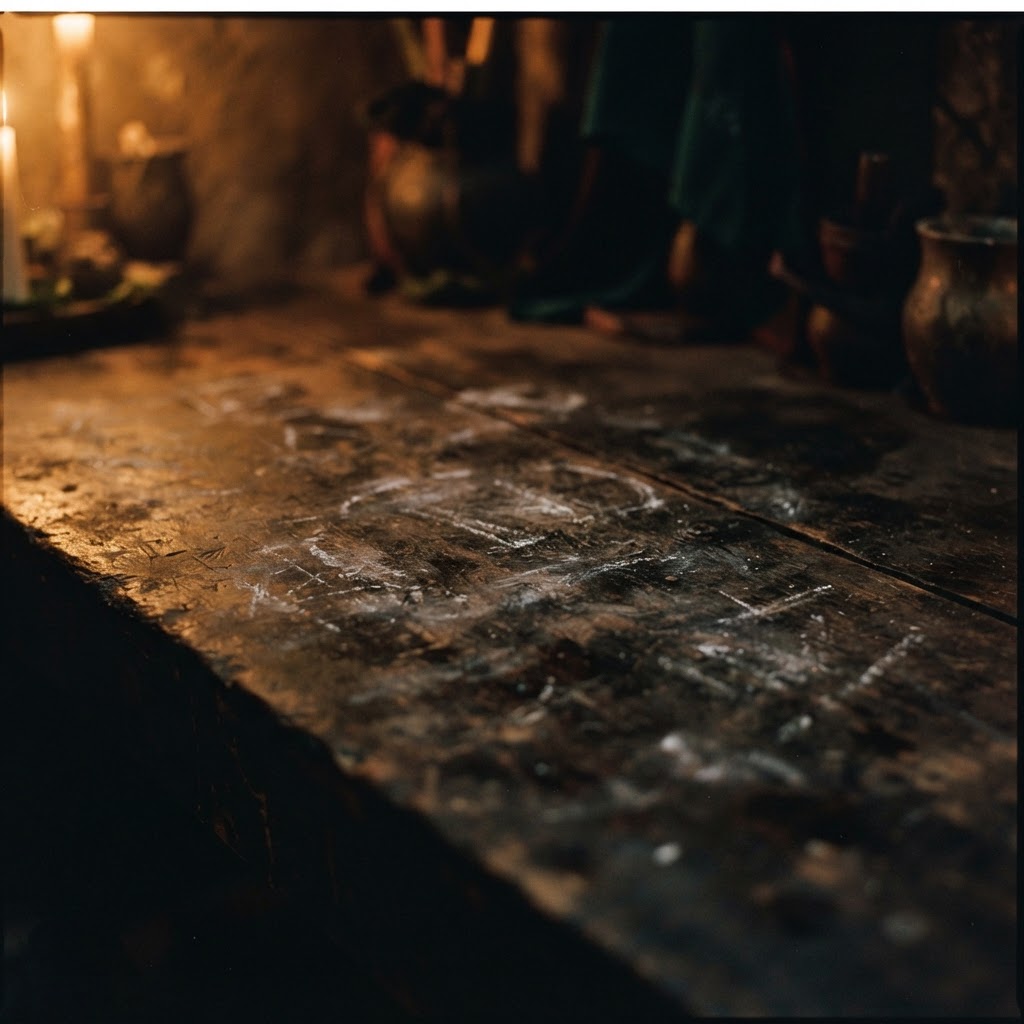
In the rich, historical landscape of Palo Mayombe, the firma is one of the most misunderstood and yet profoundly important aspects of the tradition. For those new to our community, seeing these intricate designs can be both beautiful and confusing. It is essential to approach this topic with humility, acknowledging that these marks are not merely drawings, but sacred expressions of spiritual authority and connection.
Understanding the concept of reading a firma requires shifting our perspective away from the way we interpret a Western language. In Palo, symbols are not letters that form words in a traditional alphabet. Instead, they act as a spiritual map, a signature, and a point of entry for the energies that practitioners work with within this living tradition.
At its core, reading a firma is a process of recognizing lines, shapes, and spatial relationships that convey the essence of a specific spirit or a particular intent. A firma is a visual representation that is rarely meant to be dissected symbol-by-symbol by the uninitiated. It is a holistic communication.
Short answer: A firma is a sacred spiritual signature used in Palo Mayombe to represent specific forces or intentions. It is read as a complete, unified design rather than individual symbols. Because these marks are tied to the authority and wisdom passed down through initiation, they cannot be interpreted using public dictionaries or generic keys.
When looking at the structure of a firma, you will often notice consistent elements such as straight lines, crossings, circles, points, and arrows. In the context of Palo Mayombe 101, it is taught that these elements serve as architectural supports for spiritual work. Lines often indicate direction, intent, or the movement of energy. Crossings can represent the meeting points of different spiritual realms or the intersection of paths. Circles and points often delineate sacred spaces or focus the concentration of the spirit being invoked.
However, the meaning of these shapes is not static. A line in one firma may represent something entirely different than a line in another, depending on the lineage of the practitioner and the spirit being addressed. The meaning is fundamentally bound to the spirit it names and the specific purpose for which it was created.
We see many questions online asking for a "dictionary of firmas" or a "key" to interpret these designs. It is critical to state clearly: there is no public alphabet for Palo firmas. These designs are part of a closed, initiatory tradition. They are passed down from teacher to student, often requiring years of experience to properly understand, craft, and activate.
Using online resources or books to "translate" a firma is, at best, ineffective and, at worst, disrespectful to the depth of the tradition. If you see a source claiming to have a universal guide to reading these symbols, treat it with extreme caution. True knowledge of these marks is gained through community, experience, and the guidance of those who have been initiated into the mysteries of the Mpungos.
If you are drawn to the beauty of these spiritual signatures, the best path forward is to immerse yourself in the culture and history. We encourage you to Learn more about the broader Afro-Cuban traditions through reputable sources. By focusing on the historical context and the philosophical roots of Palo, you gain a much deeper appreciation for the firmas than any superficial "code-breaking" could ever provide.
Remember that the power behind these designs is not in the ink or the chalk, but in the relationship between the practitioner and the spirit. This relationship is built over time and is rooted in deep, personal commitment to the lineage. Whether you are a newcomer or someone interested in the history of the faith, honoring the sacred nature of the firma is the first step toward understanding the profound beauty of our tradition.
Related tools
Handmade by initiated Santeros · unconsecrated, ready for your elder
$40.00

Handmade by initiated Santeros · unconsecrated, ready for your elder
$45.00

Handmade by initiated Santeros · unconsecrated, ready for your elder
$45.00
Every piece ships unconsecrated so your elder can prepare it. Free US shipping over $95 · 14-day returns.
Written by
SanteriaGuide
Initiated practitioner and writer at SanteriaGuide. Articles are reviewed by elders of the house before publication.
Before you decide
From the community
“The irofá arrived ready for work — solid, balanced, exactly as my babalawo wanted.”
Omar B. · Union City, NJ · Verified buyer
“Used the mazo in my iyawó year. It held up through everything.”
Lisette F. · Tampa, FL · Verified buyer
“Every knot tight, every bead correct. These people know the tradition.”
Rafael O. · Bronx, NY · Verified buyer
Before you begin
What to ask before any ritual work begins — and what only an initiated elder can answer.
No spam. Unsubscribe anytime.
Everything we send is a starting point. Ritual work belongs in the hands of an initiated elder — find yours before you begin.
Authenticity guaranteed
Handmade by initiated Santeros using traditional materials.
Fast, careful shipping
Ships next business day, wrapped for the altar.
30-day returns
Unused, unconsecrated pieces returned without fuss.
Secure checkout
Encrypted payment, card details never stored.
Related collection · View all 4 pieces
Palo Mayombe tools — ritual items for Tata Nkisis and Yayas, made with respect for a tradition rooted in ancestral wisdom and the forces of nature.
Keep reading